On the occasion of the European Holocaust Memorial Day for Sinti and Roma on 2 August 2026, the Bavarian Memorial Foundation commemorates this victim group
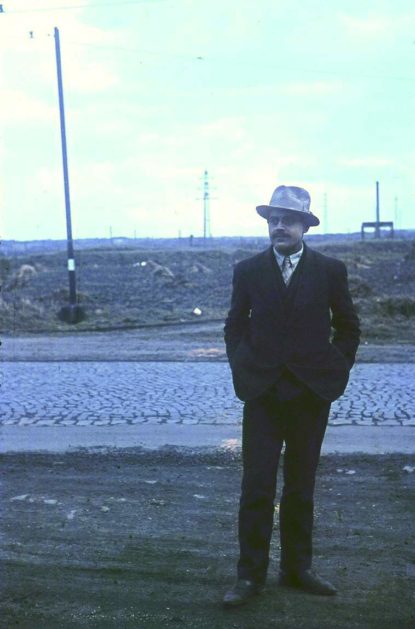
Copyright: Federal Archives Berlin
Stojan Lassisch arrived at the Bavarian concentration camp Flossenbürg on 27 May 1944 as part of a transport from Auschwitz-Birkenau in Poland. He was 35 years old. He had lost all members of his family in the Auschwitz-Birkenau extermination camp. Seven months after his arrival at Flossenbürg concentration camp, he too died as a result of the inhumane conditions there.
Stojan Lassisch’s family had come to Germany from Bosnia during the First World War. To demonstrate that they had a permanent residence, they bought a house near Aachen. His parents, Stanko and Petra Lassisch, worked as carnival performers. From the time they were registered by the police in April 1939, they were required to carry at all times a so-called ‘Gypsy identity cards’. They were considered stateless. From the summer of 1939, the family was no longer permitted to leave their place of residence. Stojan Lassisch now worked in a factory. The entire family was registered in the summer of 1939 by the then ‘Office for Gypsy Affairs’ of the Cologne Criminal Police. In January 1942, the ‘Research Institute for Racial Hygiene’ issued a report on the family.
On 2 March 1943, Stojan Lassisch, together with his wife Stana Mitrowitsch and their six children, was deported to the so-called ‘Gypsy camp’ at Auschwitz-Birkenau concentration camp. All members of the family, except Stojan, died there of starvation and disease or were murdered in the gas chambers. Meanwhile, the criminal police confiscated the Lassisch family’s entire property. After Stojan Lassisch was selected by the SS as “capable of work”, he was deported to the Flossenbürg concentration camp and died seven months later as a result of his imprisonment.
Persecution under National Socialism
After 1933, Sinti and Roma were gradually stripped of their rights and marginalised from public life in Germany. The Nuremberg Laws classified the Sinti and Roma ethnic minority as ‘foreign races’. From 1942 onwards, Sinti and Roma were deported from the German Reich and the occupied countries in Europe to the Auschwitz-Birkenau extermination camp. The Central Council of German Sinti and Roma estimates that up to 500,000 people fell victim to the Nazi murder campaigns and the appalling conditions in concentration camps.
Thousands of Sinti and Roma were also interned in the Bavarian concentration camps at Dachau and Flossenbürg. In these camps, they often occupied a very low position in the hierarchy of the prisoner community and were, for example, assigned to particularly arduous labour details.
Background to European Holocaust Memorial Day for Sinti and Roma
In 2015, the European Parliament declared 2 August as the European Holocaust Memorial Day for Sinti and Roma who were murdered in Nazi-occupied Europe. On the night of 2 to 3 August 1944, 4,300 Sinti and Roma – predominantly elderly and sick people, as well as children – were murdered by the SS in the gas chambers at Auschwitz, despite their fierce resistance.
For a long time, the Nazi persecution and murder of Sinti and Roma had been marginalised in the public memory in the Federal Republic of Germany. It was only through the efforts of the civil rights movement from the 1980s onwards that the genocide gained broader public recognition. The Dachau Concentration Camp Memorial Site was itself the site of such events, for example during the civil rights movement’s hunger strike in the Evangelical Church of Reconciliation in 1980.
The Bavarian Memorial Foundation honours the memory of all victim groups and brings their stories to public attention. Since 2016, a memorial at the Flossenbürg Concentration Camp Memorial has commemorated the Sinti and Roma who fell victim to the Nazi genocide.