
“Non posso mai fare una sola cosa.” Exhibition of artworks by the Italian concentration camp survivor Vittore Bocchetta at the Flossenbürg Concentration Camp Memorial
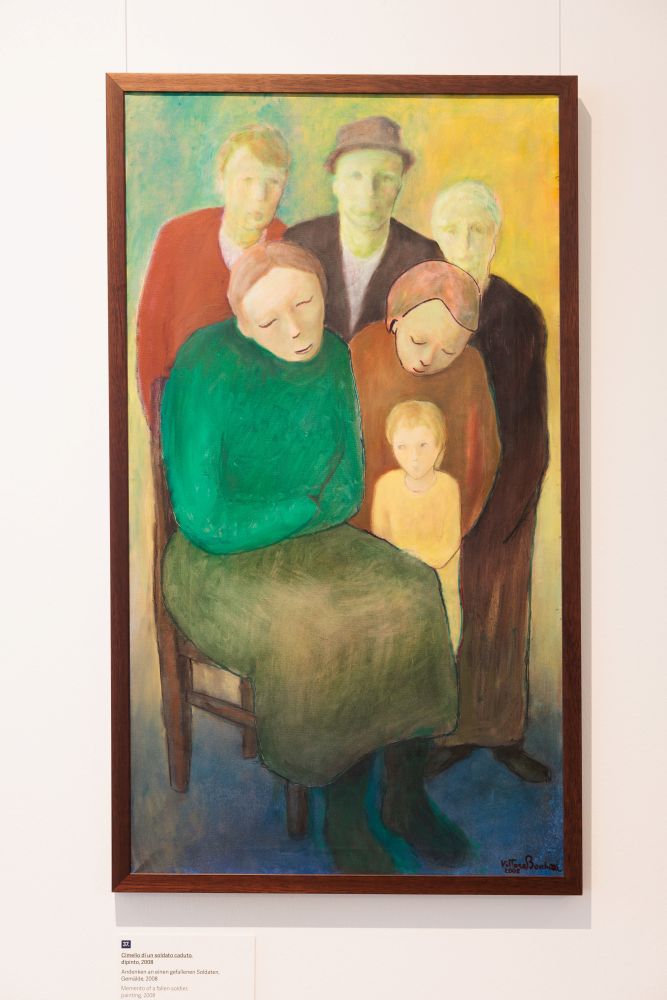
Copyright: Flossenbürg Memorial/Thomas Dashuber
“Non posso mai fare una sola cosa. Devo fare almeno tre cose. Un’ora senza fare nulla è per me come dover morire.” (“I can never do just one thing. I have to do at least three things. An hour of doing nothing feels to me like having to die.”1) Vittore Bocchetta was a professor of literature, an author, an artist, a resistance fighter, a concentration camp prisoner, a survivor and an immigrant. A seeker, a man driven by a higher purpose - a person who was always on the move.
Vittore Bocchetta was born on 15 November 1918, in Sassari on the island of Sardinia. At the age of 14, he moved with his family to Verona. As a student, he took part in the resistance against the fascist regime of Mussolini and the German occupation beginning in 1943. A year later, he was arrested and deported via Bolzano to the Flossenbürg subcamp in Hersbruck. When the camp was evacuated in March 1945, Bocchetta managed to escape and hide in a camp for British prisoners of war. After the war, he initially returned to Italy, but in 1948 he emigrated to South America and later to the United States. In 1992, Bocchetta returned to Verona, where he died on 18 February 2021.
Vittore Bocchetta began his artistic career in the 1950s as a sculptor. His work includes sculptures and texts, as well as drawings, collages, paintings and theatrical productions. He often blurred the boundaries between these genres, placing them in dialogue with one another and thereby creating his distinctive style.
The exhibition features paintings, drawings and sculptures. Most of the drawings shown were created in 1986 during a stay in Verona, when Bocchetta was also working on his autobiography.
With his sculpture ‘Untitled’ on the site of the former Hersbruck subcamp, Vittore Bocchetta created a significant place of remembrance and reflection. The artwork serves as a powerful warning against dehumanisation caused by human beings, whilst harbouring a glimmer of hope for humanity even under the most degrading conditions.
Italian prisoners at the Flossenbürg concentration camp
In September 1943, Italy ends its alliance with Germany and the “Berlin-Rome axis” collapses. Germany occupies large areas of Italy and installs a collaborationist government. The occupying forces and Italian Fascists conducted arrests and massacres among the growing resistance. The number of Italians in Flossenbürg increased rapidly when large transports from the camps near Bolzano and Trieste began to arrive from September 1944. Just under 3,000 Italian prisoners are listed in Flossenbürg records, among them 237 women. 133 were registered as Jews.
While the SS regarded the Italians as traitors who had broken the alliance, many of the prisoners considered them fascists. As a result, they were often subjected to especially harsh treatment. Over 950 Italians died in the Flossenbürg camp complex.
Editor’s Notes:
· 1Quote: Vittore Bocchetta, Art and Life. On the Exhibition of Vittore Bocchetta’s Artworks, ed. by Ingrid Schäfer, Hanse Jacobs Publishing, 2003, p. 7.
Photos attached: Vittore Bocchetta: In Memory of a Fallen Soldier, painting, 2008. Copyright: Flossenbürg Memorial/Thomas Dashuber & Vittore Bocchetta: Without a Name, sculpture, 2016. Copyright: Bavarian Memorial Foundation