Liberation commemorations in Flossenbürg and Dachau, and the inauguration of new information panels in Munich - Survivors, descendants and international guests come together to commemorate the victims of National Socialism
Munich - 12 May 2026. From 24 April to 3 May 2026, the Bavarian Memorial Foundation focused on three commemorative events: the 81st anniversary of the liberation of the Flossenbürg and Dachau concentration camps, and the ceremonial inauguration of new information panels at Ehrenhain II in the Perlacher Forst cemetery in Munich. Numerous guests from around 20 nations took part, including survivors, descendants of former prisoners, and representatives from politics, diplomacy, business and society.
81st anniversary of the liberation of Flossenbürg concentration camp - 24 to 26 April 2026
Over 1,000 guests from around 20 nations took part in the commemorations from 24 to 26 April 2026 at the Flossenbürg Concentration Camp Memorial - including more relatives and descendants of former prisoners than ever before. Four survivors of the Flossenbürg concentration camp and its satellite camps were present in person: Josef Salomonovic, Shelomo Selinger, HRH Duke Max of Bavaria and Dr Leon Weintraub.
Dr Leon Weintraub, born in 1926, opened the central commemoration ceremony on 26 April with a personal address. He urged those present to actively defend themselves against attacks on the fundamental rights of democracy. In his welcoming address, Foundation Director Karl Freller emphasised the importance of public remembrance: “It is the opposite of indifference and the foundation of a society that not only professes respect for human dignity, but lives by it.”
Other speakers included Prof. Dr Jörg Skriebeleit (Director of the Flossenbürg Concentration Camp Memorial), Joachim Herrmann (Bavarian Minister of State for the Interior, Sport and Integration), Dr Silke Launert (Parliamentary State Secretary at the Federal Ministry of Research, Technology and Space) and Xavier Ros (Chief Human Resources Officer at AUDI AG). Audi’s predecessor companies employed forced labourers from the Flossenbürg concentration camp between 1939 and 1945. Ros explained: “Remembrance needs places like this – but it also needs people who are willing to listen, to be moved by history, and who are prepared to do their part to prevent forgetting.”
Malgorzata Nieśpiałowska, daughter of the former Polish prisoner Tadeusz Nieśpiałowski, concluded her speech with an appeal to understand “Never again” not merely as lip service, but as a call to action.
As part of the celebrations, the memorial received significant donations for its collection: Denis Meis presented the medals of his father Clément Meis, a former Flossenbürg prisoner; relatives of the former prisoner Michael Smuss handed over his original prisoner number. Memorial Director Prof. Dr Jörg Skriebeleit summed up: “We have seen and felt that we are a place for families from all over the world. A place where we mourn, but also a meeting place where families come together. This character becomes clearer with each passing year.”
Inauguration of new information panels at Ehrenhain II in Munich - 28 April 2026
On 28 April 2026, the Bavarian Memorial Foundation, the Health Department of the City of Munich and Munich Prison jointly inaugurated two new memorial steles at Ehrenhain II in the cemetery at Perlacher Forst in Munich. The bilingual information panels (German/English) commemorate the 93 victims of the Nazi justice system buried at Ehrenhain II who were executed at Stadelheim Prison in Munich. Via QR codes, visitors can access more detailed biographies on a newly launched website of the Foundation.
Between 1933 and 1945, at least 1,188 people were verifiably executed at Munich-Stadelheim Prison, nearly all of them by guillotine. Among those buried at Ehrenhain II are political prisoners and resistance fighters from several European countries, including the former German Reich, Austria, Poland and former Czechoslovakia.
Foundation Director Karl Freller emphasised: “The injustice has now been clearly named. The new information here on site serves both to shed light on the crimes of the Nazi justice system and to guard against forgetting.” Over 50 descendants of the victims travelled to the inauguration; relatives from the Czech Republic were particularly well represented. Dr Ivana Červenková, Consul General of the Czech Republic in Munich, expressed her gratitude to the Bavarian side for implementing the memorial project.
81st anniversary of the liberation of Dachau concentration camp - 1 to 3 May 2026
From 1 to 3 May 2026, the Dachau Concentration Camp Memorial Site commemorated the liberation of the concentration camp and its subcamps with an extensive accompanying programme, including the guided tour “The Liberation of Dachau Concentration Camp”, which was available in German and English, as well as a memorial service at the former SS shooting range in Hebertshausen. In addition, the “Forum of Descendants” took place for the second time, an event intended to bring together the descendants of former prisoners of the Dachau concentration camp.
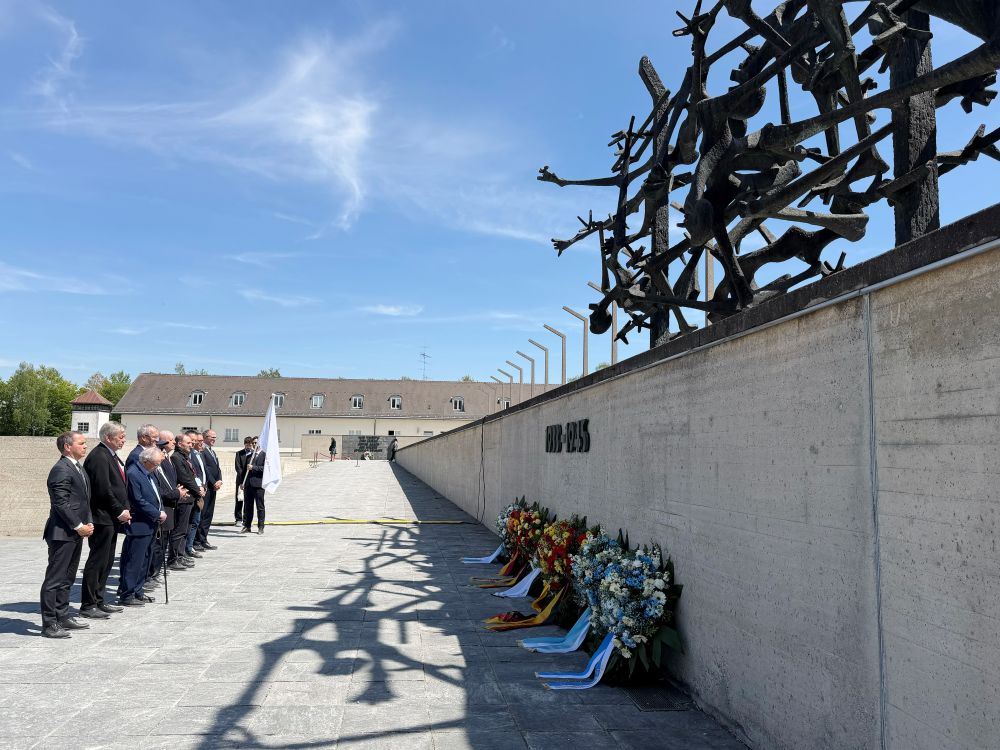
The week of remembrance concluded on 3 May 2026 with the central commemoration ceremony at the Dachau Concentration Camp Memorial Site. Around 3,000 guests from the worlds of politics, diplomacy, the churches and society, as well as survivors and descendants from all over the world, commemorated the liberation of the concentration camp by US troops on 29 April 1945.
The participation of five survivors of Dachau concentration camp and its subcamps was particularly moving: Jean Lafaurie, Lynne Farbman, Abba Naor, George Legmann and Leslie Rosenthal. At the former crematorium, Jean Lafaurie and Florian Hartmann, Lord Mayor of the City of Dachau, gave speeches. On the former roll-call square, the focus was on the commemorative messages from Lynne Farbman, born in the Mühldorf subcamp, and George Legmann, born in the Kaufering subcamp.
Following a welcome address by Dr Christoph Thonfeld, Deputy Director of the Dachau Concentration Camp Memorial Site, Foundation Director Karl Freller addressed those present in no uncertain terms: “Remembrance alone is no longer enough. We must take active steps to prevent. To prevent fascist thinking and voting from continuing to rise in our country; to prevent democracy from abolishing itself; prevent Germany from sliding back into catastrophe.” Greetings were also given by Dominique Boueilh (President of the Comité International de Dachau), Dr Robin Mishra (Head of Department at the Federal Government Commissioner for Culture and the Media) and Alexander Hold (Second Vice-President of the Bavarian State Parliament).
The proceedings concluded with a wreath-laying ceremony at the International Memorial and followed by a Day of Encounter at the Max Mannheimer House.